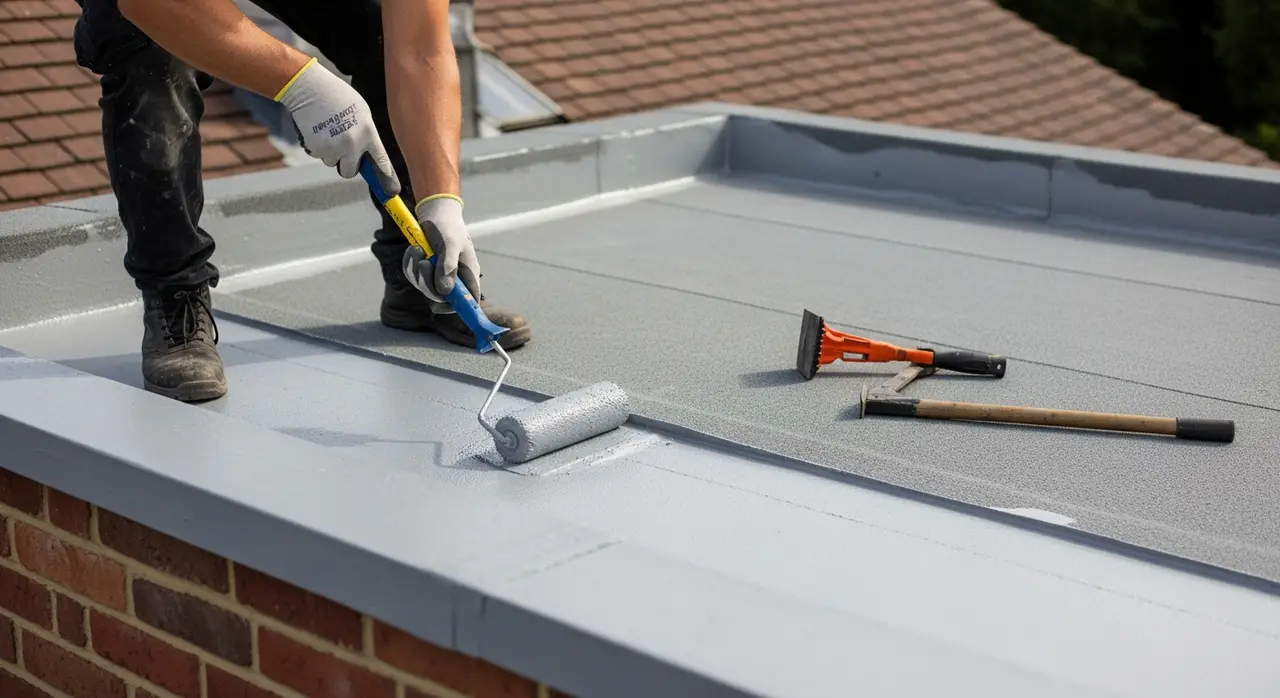
Liquid Roofing and Waterproofing
Some roofs are too detailed for sheets and rolls. City Building and Roofing Ltd install cold-applied liquid waterproofing systems across London and Surrey — seamless, joint-free protection for flat roofs, balconies, walkways and the awkward details where traditional coverings fail.
Fully insuredInsurance backed guaranteesHighly rated by customersEmergency roof repairs
View our Google ReviewsQuick Answer
Liquid roofing is a cold-applied waterproofing system: a liquid resin is rolled or brushed onto a prepared roof, where it cures into a seamless, joint-free membrane. Because it is applied wet, it seals complex details — upstands, pipes, rooflights and junctions — that sheet materials struggle with. City Building and Roofing Ltd install liquid systems on flat roofs, balconies and detailed areas across London and Surrey.
What is liquid roofing?
Liquid roofing systems are applied as a liquid resin — by roller or brush, usually with reinforcement at details — and cure into a continuous elastomeric membrane with no seams, laps or joints. Since most flat roof leaks start at a seam or a detail, removing the seams removes the most common failure mode.
Because the membrane is formed in place, it follows whatever shape the roof presents: pipe penetrations, rooflight kerbs, upstands, parapet junctions, changes of level and awkward corners all get the same continuous coverage as the open field of the roof.
Cold application is the other advantage. There are no flames and no hot bitumen, which matters on occupied buildings, timber structures and anywhere hot works are unwelcome. Many liquid systems can also be applied over a sound existing covering, avoiding a full strip-up.
Where liquid systems excel
- Flat roofs with many penetrations, rooflights or plant — where sheet laps multiply
- Balconies, terraces and walkways needing a trafficable waterproof finish
- Overlaying a tired but sound existing covering without a full strip-up
- Buildings where hot works are unacceptable — occupied, timber or heritage structures
- Complex junctions, gutters and details that keep failing under traditional coverings
What our liquid roofing service covers
Condition assessment
We check the existing roof is a sound substrate — liquid systems are only as good as what is beneath them, and we say honestly when they are not the right answer.
Preparation
Cleaning, drying, local repairs and priming as the system requires — preparation is where liquid roofs are won or lost.
Detail reinforcement
Upstands, outlets, pipes and junctions reinforced so the most vulnerable points become the strongest.
Membrane application
The liquid membrane applied at the correct coverage rates and cured to a continuous, seamless finish.
Balconies and walkways
Trafficable build-ups with appropriate surface finishes for terraces, balconies and access routes.
Written guarantee
Workmanship covered by our written guarantee, with insurance-backed cover available on eligible works.
How It Works
Survey and honest recommendation
We inspect the roof and confirm whether liquid, GRP, EPDM, felt or an overlay is genuinely the right system for it.
Itemised quotation
A written, itemised quote for the agreed system and build-up — no vague allowances.
Preparation
The substrate cleaned, repaired and primed to the system's requirements.
Application and curing
Details reinforced first, then the field coats applied at correct rates in suitable weather.
Inspection and handover
Final checks, site tidied, and your written guarantee issued.
Honest notes on liquid systems
- Application is weather-dependent — surfaces must be dry and temperatures suitable, so programmes can shift with the forecast
- The substrate must be sound; a liquid membrane over a failing deck fails with it, which is why we survey before quoting
- Overlay is not always appropriate — trapped moisture in an existing build-up sometimes means stripping is the right answer
- System life depends on correct application and specification; we install to the manufacturer's requirements rather than quoting invented lifespans
We would rather tell you the honest position than win work on promises we cannot keep.
London & Surrey Coverage
We install liquid waterproofing across London and Surrey — rear extensions and mansion block details in Kensington, Chelsea and Fulham, balconies and terraces across west London, and domestic and commercial flat roofs throughout Weybridge, Esher, Kingston, Staines and the surrounding towns.
Get a free quote
Find City Building and Roofing Ltd on Google
Customers across London and Surrey can find City Building and Roofing Ltd on Google to read reviews, view recent work and contact the team directly. We recommend calling the correct local number for your area — Surrey enquiries on 01932 950 995 and London enquiries on 020 7118 0095.
Frequently Asked Questions
How long does liquid roofing last?
Service life depends on the system specified, the substrate and the quality of application, which is why we install strictly to manufacturer requirements rather than quoting a universal number. Correctly specified and applied liquid systems are designed as long-term waterproofing, not a temporary coating — and our workmanship is covered by a written guarantee.
Can liquid roofing be applied over my existing flat roof?
Often, yes — overlaying a sound existing covering avoids the cost and disruption of a strip-up. The key word is sound: we survey first, check for trapped moisture and deck problems, and only recommend an overlay where it will perform. Where stripping is the right answer, we say so.
Is liquid roofing better than GRP or EPDM?
They solve different problems. Liquid excels on detailed, penetrated or awkward roofs and refurbishment overlays; GRP suits new plywood decks wanting a rigid, hard-wearing finish; EPDM suits simple rectangular roofs covered in one sheet. We install all three, so our recommendation is based on your roof rather than the one system we happen to sell.
Can it be used on balconies and terraces?
Yes — liquid systems are one of the best answers for balconies, terraces and walkways because they form a seamless membrane that can take a trafficable finish. Falls, drainage and edge details matter as much as the membrane, and we address all three as part of the work.
Does the weather affect installation?
Yes. Liquid membranes need dry surfaces and suitable temperatures to cure correctly, so application days depend on the forecast. We would rather move a programme by a few days than apply a system in marginal conditions — a membrane rushed into bad weather is a warranty claim waiting to happen.
Is there any fire risk during installation?
Liquid systems are cold-applied — no flames, torches or hot bitumen — which is one of their main advantages on occupied buildings, timber structures and properties where hot works are unwelcome or restricted. Curing produces some odour with certain systems, which we manage and advise on beforehand.
Ready to Get Started?
Contact us today for a free, no-obligation quote. We serve all of London and Surrey with professional roofing and building services.
Free quotes · No obligation · Fast response