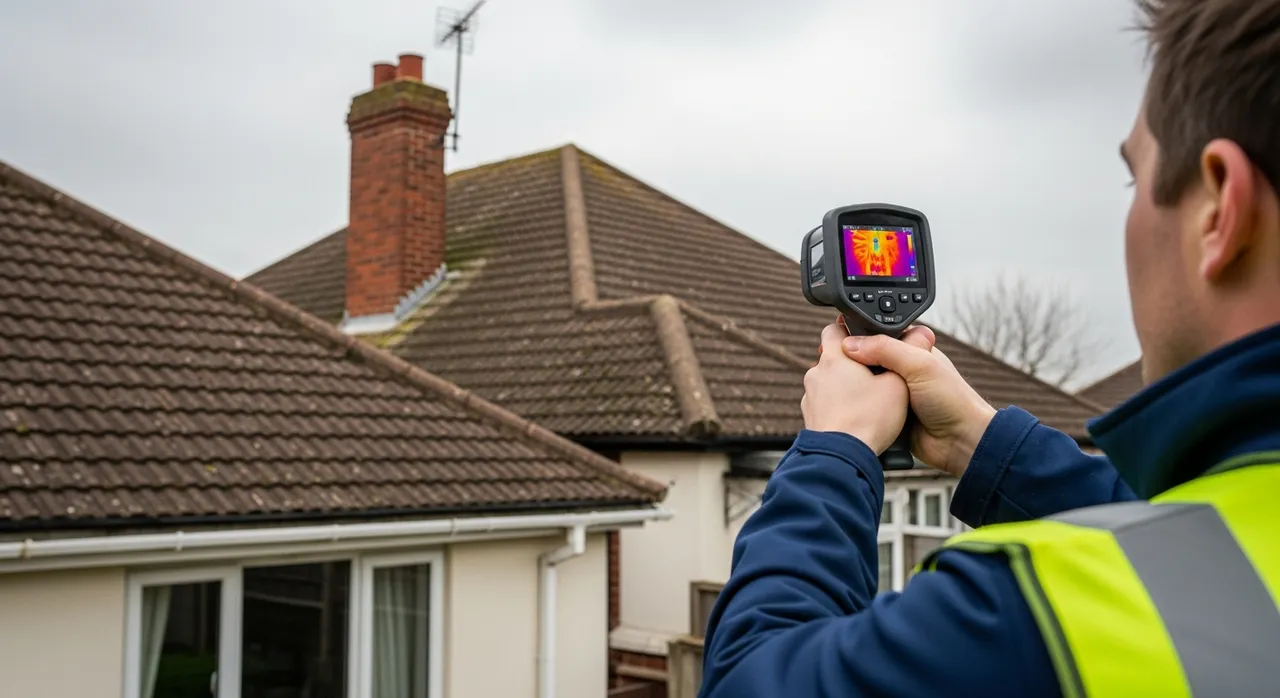
Thermal Imaging for Roof Leak Detection
Thermal imaging helps experienced roofers see patterns invisible to the eye — temperature differences that can indicate trapped moisture or missing insulation. City Building and Roofing Ltd use it where appropriate as part of structured leak investigation across London and Surrey.
Fully insuredInsurance backed guaranteesHighly rated by customersEmergency roof repairs
View our Google ReviewsQuick Answer
Thermal imaging assists roof leak detection by showing surface temperature differences that can indicate damp materials, trapped moisture or missing insulation. It does not see through a roof and is not conclusive on its own — conditions must suit it and findings must be interpreted by experienced roofers. City Building and Roofing Ltd use thermal imaging where appropriate within a wider investigation across London and Surrey.
How thermal imaging assists leak diagnosis
A thermal camera measures the temperature of surfaces. Damp materials heat and cool at different rates from dry ones, so under the right conditions a wet patch of insulation, deck or plaster can show as a distinct thermal pattern — even when the surface looks perfectly normal to the eye.
That makes thermal imaging a genuinely useful assistant in leak investigation: it can help narrow the search area, reveal the extent of moisture spread beyond a visible stain, and highlight missing or slumped insulation that mimics damp problems.
What it is not is an X-ray. It reads surface temperature only, it cannot see through materials, and thermal patterns have multiple possible causes. That is why we use it as one tool inside a structured investigation, interpreted by roofers who understand how roofs actually fail — never as a gimmick that replaces inspection.
Where thermal imaging earns its place
- Flat roofs where moisture may be trapped within the build-up beyond the visible leak
- Establishing how far water has spread from a known entry point
- Recurring leaks where conventional inspection has not produced a confident diagnosis
- Suspected missing, slumped or wet insulation behind ceilings and in roof build-ups
- Distinguishing damp patterns from cold-bridging and condensation effects
What a thermal-assisted investigation involves
Conditions check
Thermal surveys need a suitable temperature difference and dry survey conditions; we confirm whether your situation suits the method before recommending it.
Internal thermal scan
Scanning ceilings and roof undersides for temperature anomalies consistent with moisture or insulation defects.
External inspection
Thermal findings are always paired with physical inspection of the roof above — the camera narrows the search, the roofer confirms the cause.
Moisture confirmation
Where a thermal anomaly suggests damp, we corroborate it with visual evidence and the water path before drawing conclusions.
Interpreted findings
You receive the relevant thermal images with a plain-English explanation of what they indicate — and what they cannot confirm.
Repair recommendations
A clear next step: the specific repair, further monitoring, or targeted opening-up where the evidence justifies it.
How It Works
Suitability assessment
We discuss the symptoms and confirm whether thermal imaging is likely to add value for your roof and conditions.
Survey visit
Internal scanning of affected areas combined with external roof inspection on the same visit.
Interpretation
Thermal patterns are assessed alongside physical evidence — never in isolation.
Findings and explanation
Annotated images and honest conclusions: what is confirmed, what is probable, what remains uncertain.
Quotation for repairs
Where a defect is identified, an itemised written quotation for the specific repair.
What thermal imaging cannot do
- It measures surface temperature only — it does not see through roofs, walls or coverings
- Results depend on conditions: a sufficient temperature difference, dry surfaces and suitable weather are needed for meaningful images
- Thermal anomalies have multiple possible causes — cold bridging, air leakage and insulation gaps can mimic moisture patterns
- It assists diagnosis; it does not replace physical inspection and cannot guarantee certainty on its own
We would rather tell you the honest position than win work on promises we cannot keep.
London & Surrey Coverage
Thermal-assisted leak investigation is available across London and Surrey where the roof and conditions suit the method — particularly flat-roofed extensions and terraces in west London and larger properties across Weybridge, Esher, Cobham and the Thames-side towns. Availability and suitability are confirmed when you enquire.
Request availability and quotation
Find City Building and Roofing Ltd on Google
Customers across London and Surrey can find City Building and Roofing Ltd on Google to read reviews, view recent work and contact the team directly. We recommend calling the correct local number for your area — Surrey enquiries on 01932 950 995 and London enquiries on 020 7118 0095.
Frequently Asked Questions
Can a thermal camera see through my roof?
No — and any company implying it can is overselling. A thermal camera reads the temperature of surfaces. Because damp materials change temperature differently from dry ones, it can reveal patterns consistent with moisture, but it cannot look through tiles, membranes or plaster. Interpretation by an experienced roofer is what turns the image into a diagnosis.
Does thermal imaging find every leak?
No. It needs suitable conditions — a meaningful temperature difference and dry survey weather — and some construction types mask thermal patterns. It is a genuinely useful assistant that narrows the search and reveals moisture spread, but we use it alongside physical inspection, not instead of it. Where it will not add value, we will tell you before you pay for it.
When is the best time for a thermal roof survey?
When there is a clear temperature difference between inside and outside — typically early morning, evening or the cooler months — and when surfaces are dry. Recent heavy rain followed by dry conditions can be ideal for moisture detection. We advise on timing when you book.
Can thermal imaging check my insulation too?
Yes — the same survey often reveals missing, slumped or wet insulation, which shows as distinct temperature patterns on ceilings and roof slopes. Cold-bridging and air leakage also appear, which we distinguish from moisture indications when interpreting the images. We report roofing and insulation observations; we do not provide energy certification.
Is thermal imaging worth it for a flat roof leak?
Flat roofs are where it earns its keep most often. Water entering a flat roof can spread within the build-up far beyond the visible entry point, and thermal patterns can indicate the extent of trapped moisture — useful for deciding between a local repair and a larger re-covering. Findings are corroborated physically before we recommend either.
What do I receive after the survey?
The relevant thermal images with plain-English annotations, an explanation of what they indicate and what remains unconfirmed, and — where a defect is identified — an itemised written quotation for the repair. Honest reporting matters more to us than a dramatic-looking heat map.
Ready to Get Started?
Contact us today for a free, no-obligation quote. We serve all of London and Surrey with professional roofing and building services.
Free quotes · No obligation · Fast response